PV Cable Ageing: Sunlight, Ozone and Humidity Together
One weathering test published by KUKA CABLE runs for 2,000 hours under a xenon lamp, which the manufacturer equates to about 360 weathering cycles of intense sunlight, humidity and ozone. Those three stressors rarely arrive one at a time on a roof, so the question worth asking is not which of them shortens a cable's life, but how a cable is tested when all three act together.
Key takeaways
- The manufacturer arranges a 2,000-hour xenon lamp UV test on its solar cable, described as about 360 weathering cycles.
- Insulation and sheath are XLPO, electron-beam cross-linked and LSHF, the part of the build that resists light, moisture and ozone at the same time.
- Elongation at break is stated as reaching up to 185%, against an EN 50618 requirement of more than 125%.
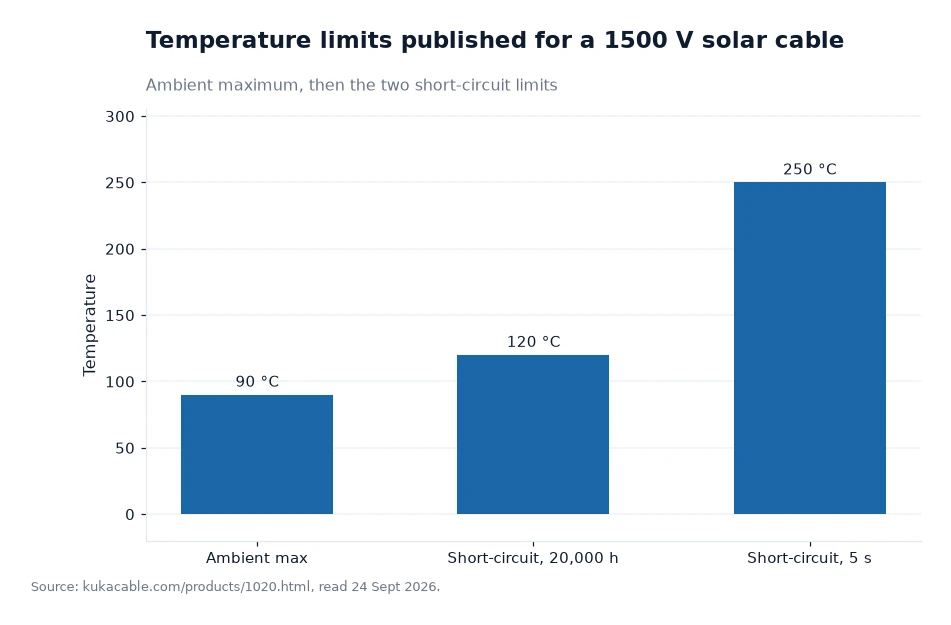
- The published window runs from −40 °C to +90 °C ambient, with short-circuit values of +120 °C for 20,000 hours and +250 °C for 5 seconds.
Why one bench tests three stressors at once
A cable fixed to a mounting rail meets ultraviolet radiation every clear day, ozone in the air around inverters and switchgear, and water vapour that rises and falls with the weather. Treating them as separate problems misses the point, because the damage compounds: UV breaks polymer chains, moisture works into the cracks that follow, and ozone attacks the same exposed surface. The client keeps a dedicated content section on solar cable construction, characteristics and what it calls the dangers of cutting corners, and that section treats UV stability as a property of the finished compound rather than an additive.
The published figure is 2,000 hours on a xenon lamp bench, equated by the manufacturer to roughly 360 weathering cycles. A xenon lamp is used because its spectrum sits close to daylight; a bench that only shines light would miss the humidity and ozone. The test is presented as evidence of insulation integrity and stable electrical performance in harsh conditions, which is a narrower claim than a service-life prediction, and it is worth reading it that way.
What the laboratory adds to the picture
The speciality cable laboratory was established in December 2015 and is described by the company as an ISO/IEC 17025 laboratory. Alongside UV accelerated weathering it publishes water resistance, abrasion, cold bending, cold elongation, tensile testing after ageing, solderability, static flexibility, and construction and dimensional testing. The published list of laboratory test pages is worth reading before a quotation, because a supplier that cannot name its benches usually cannot name its figures either. Anyone specifying a pv cable can hold a quote against that list and see what is missing. The manufacturer states that TUV EN 50618 sets a high benchmark for UV stability and that it aims above that benchmark, and it describes TUV certification as the starting point rather than the finish line.
Finished cable is inspected across electrical, mechanical and environmental performance under the company's own SIF quality model, which also covers raw-material selection, digital control of manufacturing, and sample retention for traceability. That last item is the one buyers use later: if a joint fails in year nine, a retained sample and a traceable batch record are what turn a complaint into an investigation.
The compound ages, the copper mostly does not
On the 1500 V solar cable page the conductor is tinned copper, class 5 flexible according to IEC 60228, and both insulation and sheath are XLPO, electron-beam cross-linked and LSHF. Electron-beam cross-linking is the ageing answer here: the polymer becomes a three-dimensional network instead of a thermoplastic that softens and flows, so it holds shape under heat and resists the cracking that sunlight starts. Tinning matters for a different reason, keeping the copper surface stable where moisture and salt are present.
Dimensions move with cross-section. A 6 mm² conductor is built from 84 strands of 0.29 mm; a 4 mm² from 56 strands of the same wire. The lighter builds are the ones most often chosen for long string runs, and the arithmetic on the published cross-section table is simple: 4 mm² weighs 59 g/m, 6 mm² weighs 78 g/m, and 10 mm² weighs 130 g/m. The same table is the one to print before a site survey, because diameter drives both the bending radius and the cable clip spacing.
Temperature sits on the same datasheet
Ageing is inseparable from heat, and the manufacturer publishes its temperature limits in the same table as the mechanical data. Ambient operation is rated from −40 °C to +90 °C. Short-circuit withstand is split into two durations: +120 °C sustained for 20,000 hours, and +250 °C for 5 seconds. Production includes a 10 kV spark test, and the finished cable is given a 6.5 kV AC test at 50 Hz for 5 minutes. A vertical flame test on a single cable runs at 800 °C for one minute, after which the cable is expected to extinguish itself.
| Published item | Value as stated | Where it appears on the site |
|---|---|---|
| Xenon lamp UV test | 2,000 hours, about 360 weathering cycles | Solar cable laboratory pages |
| Elongation at break | Above the EN 50618 requirement of 125%, reaching up to 185% | Laboratory and product pages |
| Ambient temperature | −40 °C to +90 °C | 1500 V solar cable data |
| Short-circuit, long duration | +120 °C for 20,000 hours | 1500 V solar cable data |
| Short-circuit, short duration | +250 °C for 5 seconds | 1500 V solar cable data |
| Vertical flame test | 800 °C for one minute, then self-extinguishing | Solar cable topic pages |
Worked example: putting a number on one weathering cycle
Take the two published figures and do the division. If 2,000 hours on the xenon bench stands for about 360 outdoor weathering cycles, then one cycle is represented by roughly 5.6 hours of bench time (my own calculation, using the manufacturer's equivalence of 2,000 hours to about 360 cycles). Nothing in that number says a cycle equals a month or a year outdoors; it says only how finely the bench slices the exposure.
A second piece of arithmetic uses the elongation figures. The requirement is more than 125% and the stated result reaches up to 185%. Dividing 185 by 125 gives 1.48, so the published result sits about 48% above the floor (my own calculation, comparing the two published percentages directly). That is the margin a buyer is really paying for when a supplier quotes a UV-tested compound instead of a generic one.
Reading the temperature chart
The chart reproduced below is not a UV chart. It is the manufacturer's published temperature data for its 1500 V solar cable, included here because heat and sunlight age a compound through the same chemistry. Three bars appear: 90 °C as the ambient maximum, 120 °C as the short-circuit temperature held for 20,000 hours, and 250 °C as the short-circuit temperature allowed for 5 seconds. The first bar describes everyday operation; the other two describe what the cable survives when a fault pushes current through it.
Frequently asked questions
Does a 2,000-hour xenon lamp test prove a 25-year service life?
No. The manufacturer publishes the test as 2,000 hours on the bench, equated to about 360 weathering cycles, and separately states a service life often lasting 25 years or more. The two figures come from different methods, and the site does not publish a conversion from one to the other.
Which published figure should a buyer check first?
Start with elongation at break before and after ageing, because it shows how much flexibility the compound keeps once UV, humidity and ozone have done their work. The site states a requirement of more than 125% and a result reaching up to 185%.
Documents worth requesting before approval
Ask for the xenon lamp report with its cycle equivalence stated, the elongation figures before and after ageing, and the cross-section table for the sizes you intend to order. Ask which standard the cable is tested against — the site names TUV 2PfG 1169/08.2007, EN 50618:2014 and IEC 62930 — and request the certificate list from the certificates page, which gives more than 30 types including TUV, IEC, CE, SAA and UL. The published test list is the document to attach to an enquiry, since it names the benches rather than the benefits. The manufacturer does not publish MOQ, unit prices, lead times or warranty terms on its website, so treat those as questions for a written quotation rather than something to infer from a datasheet. KUKA CABLE states that products and services have reached customers in more than 120 countries, which is a reach figure, not a substitute for the test data above.
The ageing figures above are the manufacturer's own website content; the temperature limits for 20,000 h and 5 s were logged 24 Sept 2026[1].