A first ODM fragrance order feels uncertain because most of the work happens at the supplier while the retailer waits. That asymmetry disappears once the order is mapped as a sequence: what the retailer decides, what the manufacturer develops, and where the two have to meet. For a retailer's own brand, the decisions that matter most are the range architecture, the price architecture and the release criteria, and all three are cheaper to make before development starts than after the first sample arrives.
Key takeaways
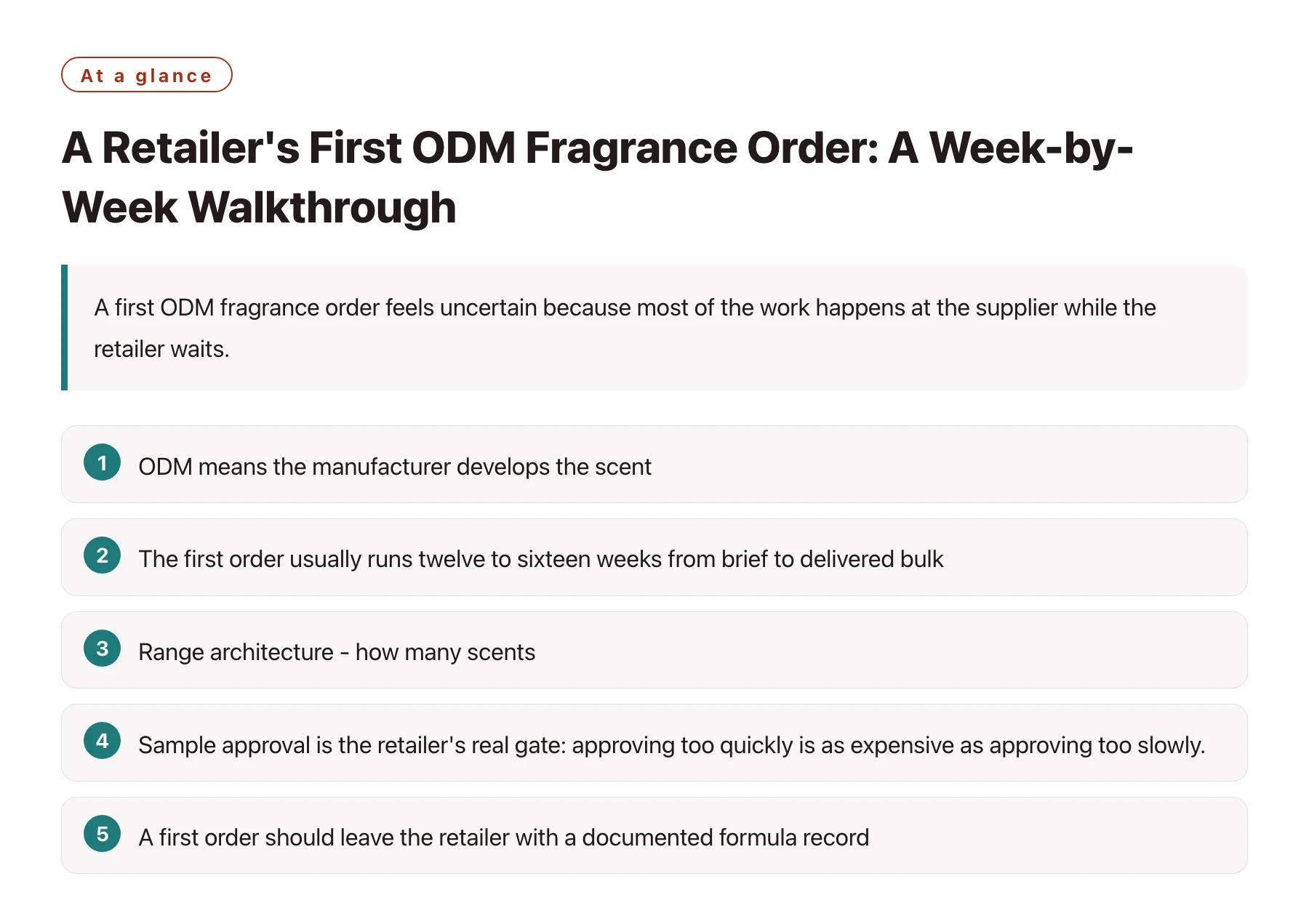
- ODM means the manufacturer develops the scent, so the retailer's main inputs are the brief, the range architecture and the approval decisions.
- The first order usually runs twelve to sixteen weeks from brief to delivered bulk, and the retailer controls fewer of those weeks than it expects.
- Range architecture - how many scents, in which sizes - should be settled before development, because it changes the development plan more than any brief detail.
- Sample approval is the retailer's real gate: approving too quickly is as expensive as approving too slowly.
- A first order should leave the retailer with a documented formula record, a retained reference and a clear picture of the reorder path.
ODM fragrance development is often described from the factory side: brief intake, bench work, sampling, modification, bulk. Useful, but it leaves out the retailer, whose decisions set the constraints. This walkthrough follows a first order from week zero to delivery, with the retailer's tasks marked as clearly as the manufacturer's.
The sequence below is a planning shape rather than a fixed rule, and it will compress or stretch with the number of scents, the novelty of the brief and the availability of components.
What changes when the manufacturer develops the scent
In an OEM arrangement the retailer brings a formula or a specification and the factory produces it. In ODM fragrance development the factory interprets a brief and creates the scent, then produces it. The retailer's job shifts from specifying a formula to specifying an outcome: what the range must do, for whom, at what price, on what shelf.
That shift is why the brief matters more in ODM work, and why a vague brief is expensive. A manufacturer such as Xuelei ODM fragrance manufacturer can propose a direction from a short brief, but each additional constraint discovered later - a note the retailer dislikes, a price ceiling that rules out a material, a pack that limits the fill - sends the bench back to work. Retail own-brand ranges have also taken a larger share of beauty assortments in recent years, which is one reason more factories now offer development alongside filling [3].
It also changes what the retailer owns. In ODM development the formula usually remains the manufacturer's intellectual property unless exclusivity is purchased, and the retailer owns the brand, the artwork and the customer relationship. Both arrangements are normal; the mistake is assuming one while contracting for the other.
The first order, week by week
- Weeks 0-1: brief and range architectureSettle how many scents, which sizes, and the retail price points. Confirm the brief in writing and agree the development fee if there is one.
- Weeks 1-3: first samplesThe bench works from the brief. Expect directional samples rather than finishes, and review them side by side rather than one at a time.
- Weeks 3-5: modification roundsComment on structure rather than adjectives: what is too loud, too sweet, too short-lived. Two rounds is typical; three is not unusual for a first brief.
- Weeks 5-7: selection and specificationChoose the scents that will go forward and freeze the concentration, fill and pack. This is where a a manufacturer that supports OEM and ODM can move fastest, because the same team carries the formula into production.
- Weeks 7-9: pack and artworkConfirm the container, the decoration and the label, including the market-specific wording the retailer owns. Order long-lead components now.
- Weeks 9-11: bulk and QCCompounding, resting and filling. The retailer approves the bulk against the retained reference and receives the record with the shipment, together with the testing evidence that supports the release [2].
- Weeks 11-14: decoration, packing and deliveryFirst article approval, packing, documents and freight. Reorder quantities and lead time should be confirmed before this point, not after.
The two decisions that shape everything else
Everything downstream of the brief is easier if two decisions are made early: how many scents the first order contains, and what the retailer will do if one of them is not liked.
How many scents in the first order
Three scents at a modest volume is a different project from one scent at volume, even when the total liquid is identical. More scents mean more samples, more approvals, more artwork, more pack components and a longer, more expensive programme. Retailers that start with a single hero scent and add flankers on reorder usually reach the shelf sooner, and the second order is easier because the process is already proven.
A related decision is whether the range shares a pack. Sharing a container across two or three scents reduces tooling and decoration cost considerably, and it makes the range read as a family on shelf. The trade-off is that all the scents must fit the same fill and the same presentation.
What happens if a sample is not right
Pre-agree the number of modification rounds included in the development fee, and what happens beyond that number. Most programmes include a defined number of rounds; beyond it, additional bench time is chargeable. Knowing the threshold prevents an awkward conversation at exactly the moment when the retailer is least willing to compromise.
It also helps to say who tests the sample and against what. Retail own-brand teams often involve store colleagues, and a structured panel with a written scoring form produces more usable feedback than a group discussion. Formulation work is constrained by ingredient restriction standards, so any feedback that pushes toward a higher impact level should be checked against the restriction framework early rather than after selection [1].
What to have ready before week one
The first order moves faster when the retail side arrives prepared. The essentials are a written brief with a price ceiling, the range architecture, the pack direction if it is already known, the markets the product will be sold in, and a named person who can approve a sample within a few days.
It also helps to look at how the manufacturer has handled similar programmes before. Reviewing the brands behind these scents and asking what the retailer side contributed in each case turns a portfolio into a process description, and it gives a clearer sense of what a first order will feel like in practice.
Finally, understand the entity you are contracting with. Looking at Xuelei's manufacturing background takes a few minutes and answers a question that first-order buyers often leave until later: whether the company that presents the capability is the company that will hold the specification, the records and the tooling.
Treat the first ODM order as a process purchase rather than a product purchase. If the programme ends with a good scent but no usable formula record, no retained reference and no agreed reorder path, the second order will cost almost as much to set up as the first.
Sources
- IFRA Standards Library (International Fragrance Association) —— The IFRA Standards Library lists the restrictions the fragrance industry applies to individual fragrance ingredients, based on safety assessments; it is the reference point for compliant fragrance formulation.
- SGS: Cosmetics, Personal Care & Household Testing —— Testing, inspection and certification services for cosmetics and personal care, including microbiological, stability and safety testing aligned with cosmetics GMP.
- Cosmetics Business —— A trade publication covering the beauty and cosmetics industry, including fragrance launches and regulatory developments.
Frequently asked questions
How long does a first ODM fragrance order take?
Twelve to sixteen weeks from confirmed brief to delivered bulk is a realistic planning range for a small own-brand range. The biggest variables are the number of scents, the number of modification rounds and the lead time on the container and decoration.
Does the retailer own the formula in ODM development?
Usually not, unless exclusivity or ownership is purchased and written into the agreement. In a standard ODM arrangement the manufacturer retains the formula and the retailer owns the brand assets. Both models work; the important step is knowing which one you have before development starts.
How many sample rounds should a first order include?
Two modification rounds after the initial samples is a common baseline, with a defined charge beyond that. Ask for the number in writing, and plan who will review each round so that feedback arrives as one consolidated response rather than several partial ones.
Should a first ODM order use one scent or several?
One hero scent is usually faster and cheaper to launch, and it makes the approval process easier to run. Several scents make sense when the shelf needs a family and the retailer can support the extra artwork, components and approvals.
What documents should the retailer keep after the first order?
The approved specification, the retained reference sample, the batch record for the delivered lot, the artwork files and the compliance documents for each market. These are the records that make a reorder routine and a complaint answerable.