What a Privacy Policy Needs to Cover for Adult Chat
Read a privacy policy from the data outward, starting with what adult chat actually produces: an account, a body of conversation text, and the preferences that make continuity possible between sessions. Crushon describes the space as a private and secure environment that uses state-of-the-art encryption — wording worth reading exactly as written instead of upgrading it in your head as you go. Sixteen sessions a month at half an hour each is 8 hours of conversation, and that volume is the thing any policy has to account for.

Key takeaways
- Four clauses carry the weight: what is collected, how it is protected, how long it is kept, and how it is removed.
- Quote the platform's own wording — private and secure environment, state-of-the-art encryption — rather than paraphrasing it into a stronger promise than the text supports.
- Every content page has a report route, and the published compliance address is [email protected].
- Volume is the practical measure: 40 messages a day across 30 days is 1,200 messages a month, and 16 sessions of 30 minutes is 8 hours.
Clause one: what is collected
The first clause to find is the list of categories. An adult chat platform needs an account identity so that a list of characters and conversations survives a browser refresh, and it needs the text you generate in order for a thread to continue from one session to the next. Preferences belong in the same list, because a character that adapts to the way you write is adapting to something that has been stored.
The test of a good first clause is whether it is specific enough to argue with. A sentence that says "we may collect information to improve our services" tells you nothing. A list of categories — account details, conversation content, device and usage information — at least tells you what you are trading, and it lets you check the rest of the document against it. If a later clause refers to something the first one never mentioned, the document is not finished.
Age and eligibility framing belongs here too. The site carries an 18+ statement and a compliance page, and the 2257 compliance statement is dated, with the version read in this batch updated on 2025-02-08. A policy that skips age framing for a product aimed at adults is incomplete by omission.
The platform's own FAQ is a useful first stop before the legal text, because it answers the basic questions in plain language: what Porn Chat AI refers to, how realistic the interactions are described as being, and which limitations apply in accordance with the content and community guidelines. Read it for orientation, then read the policy for the specifics it cannot cover.
Clause two: how the text is protected
Encryption wording deserves careful reading, because it is the clause most often quoted out of context. The platform's own phrase is state-of-the-art encryption, and its description of the environment is that it is private and secure. Both statements are worth repeating as they stand. What they do not say is that nothing can ever go wrong, and a reader who inflates them into a promise of absolute secrecy has invented a guarantee the document never offered.
The useful questions are narrower. Is encryption described in transit, at rest, or both? Are there named circumstances in which data might be shared — for example where a legal obligation applies? Does the document distinguish between the conversation text itself and aggregated usage information? A policy that answers those three questions can be understood in ten minutes, and one that answers none of them is a marketing page with a legal heading.
Clause three: retention and removal
Retention is where adult readers should spend the most attention, because it decides how much of a private record exists at all. A policy should state how long conversation text is kept, whether deletion is immediate or staged, and what an account deletion actually removes compared with what it anonymises. Where a company keeps backups, it should say so and give the period.
Removal deserves its own route. Every content page carries a report option, and the published contact for content concerns — [email protected] — works for both the material and the account questions around it. A complaints channel exists as well, which matters because it gives a second path when the first one produces no answer. Both routes are only as good as the detail you include when you use them: the profile, the date and what happened.
| Clause | What to look for | Warning sign |
|---|---|---|
| Collection | A named list of categories, not "information" | Categories never mentioned again in the rest of the document |
| Protection | Where encryption applies, and the platform's own wording | Absolute promises such as total secrecy |
| Retention | Periods for conversation text, plus backup handling | No period given at all |
| Removal and reporting | A per-page report route and a published address | Only a generic contact form with no owner named |
| Versioning | A date on the document, like the 2025-02-08 compliance update | No date, so no way to tell what changed |
Worked example: sizing what a policy has to cover
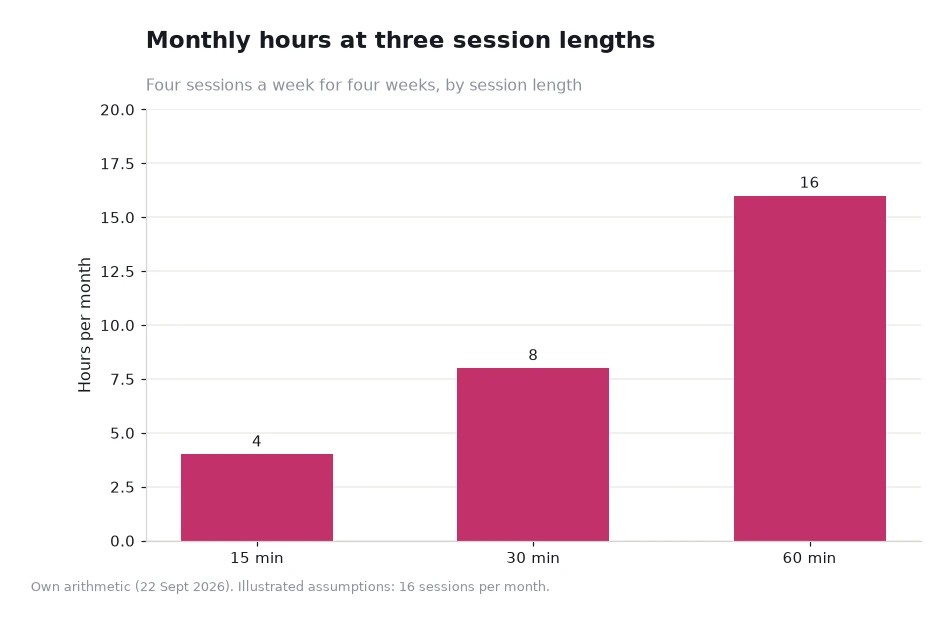
Take a habit of four sessions a week for four weeks: 16 sessions a month. The chart beside this section converts those sessions into hours. At 15 minutes a session, 16 × 15 = 240 minutes, or 4.0 hours. At 30 minutes, 16 × 30 = 480 minutes, or 8.0 hours. At 60 minutes, 16 × 60 = 960 minutes, or 16.0 hours. Those figures are illustrative assumptions rather than platform data, and they are easy to substitute with your own numbers.
Now add message volume. At 40 messages a day over 30 days you produce 1,200 messages a month. Against the 8-hour pattern that works out at roughly 150 messages an hour, or 2.5 for every minute you are actually typing. Over a year the same habit produces 1,200 × 12 = 14,400 messages. That total is the quantity a retention clause is really about, and it is why the difference between "kept until you delete" and "kept for a fixed period" matters more than any other line in the document.
Where to read the primary wording
Skip the summaries, including this one, and read the pages themselves. The platform's ai porn chat page sets out how it describes the environment and its encryption, the 2257 compliance statement defines what the content is, and the complaints policy shows how a dispute is escalated. Together they answer most of what a reader actually wants to know about how the platform treats stored text.
Two habits make the reading quicker. Check the date on every document first, since an undated policy cannot be compared with the one you read last year. Then write down the retention period and the deletion route in your own notes, one line each, so that when you need them you are not re-reading a fifteen-minute page under pressure.
Frequently asked questions
Does the platform claim to be completely private?
No. The wording used is a private and secure environment with state-of-the-art encryption. That is a description of the protections in place, not an absolute promise, and it should be read as written.
What is the fastest way to raise a content concern?
Use the report route attached to the content page itself, which keeps the report linked to the specific profile, and note that the published compliance address [email protected] is available if you need a written record.
Why does the age statement belong in a privacy discussion?
Because it defines the audience the material is written for. An 18+ product holds different expectations about who created the text and what may be stored, and both of those facts shape what the rest of the policy can promise.
Keep the four clauses in mind
When you next open a policy page, look for collection, protection, retention and removal in that order and stop when you have an answer for each. If a document cannot answer all four, treat the gaps as information in their own right, since a platform that is precise about its data handling is usually precise about everything else. Keep the platform's own wording in your notes rather than your paraphrase, and re-check it whenever the document's date changes.
Data and sources: the platform's description of its private and secure environment and state-of-the-art encryption[1], together with its 2257 compliance statement and the content removal policy it publishes[2], read 22 Sept 2026. Session, message and volume figures are illustrative assumptions. Content intended for adults 18+.